
Interactive narrative design, made with ❤️ — and it’s free
Ripple Effect is a desktop application for writing branching narrative. You lay passages out on a canvas, wire each choice to what it leads to, and press play to walk the result — over a folder on your own disk.
Free, and there is no account to make. Every platform, and how to install
Early days — you may still meet the odd rough edge.
Everything is a file
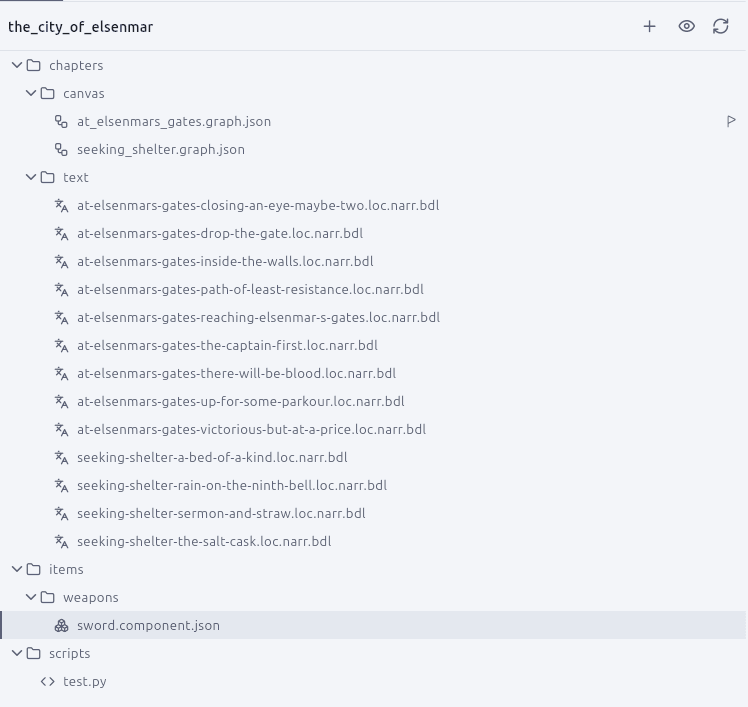
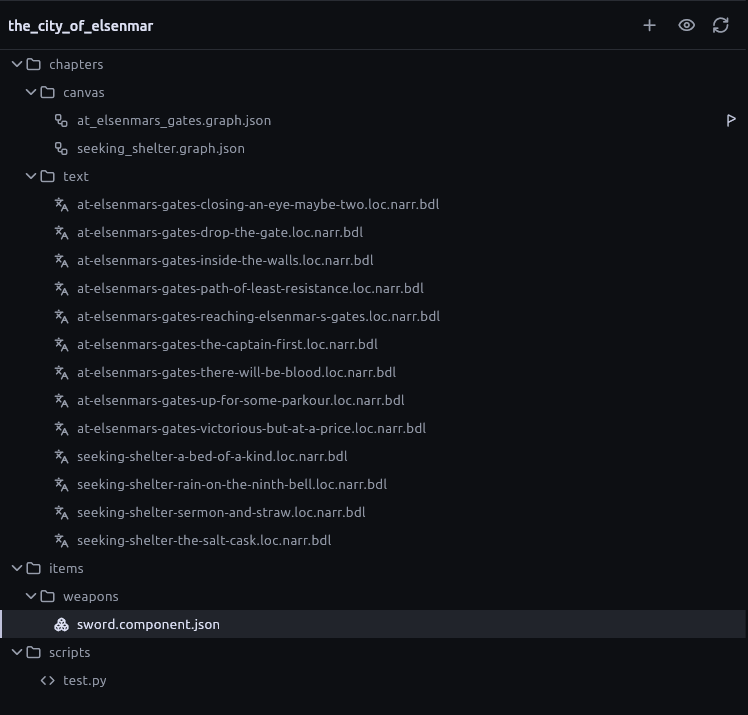
A project is a view onto a folder. The app writes no scaffold into it, imposes no layout and claims no ownership — open a directory you already have and it is a project.
No proprietary, opaque format
Boards are JSON. Prose is Markdown. Scripts are .py. Every one of them opens in any editor you already trust, and keeps working if this app disappears.
Meant for version control
Stable ids, sorted keys and relative paths, so a diff reads as prose and two people can work on the same story without fighting over a binary blob.
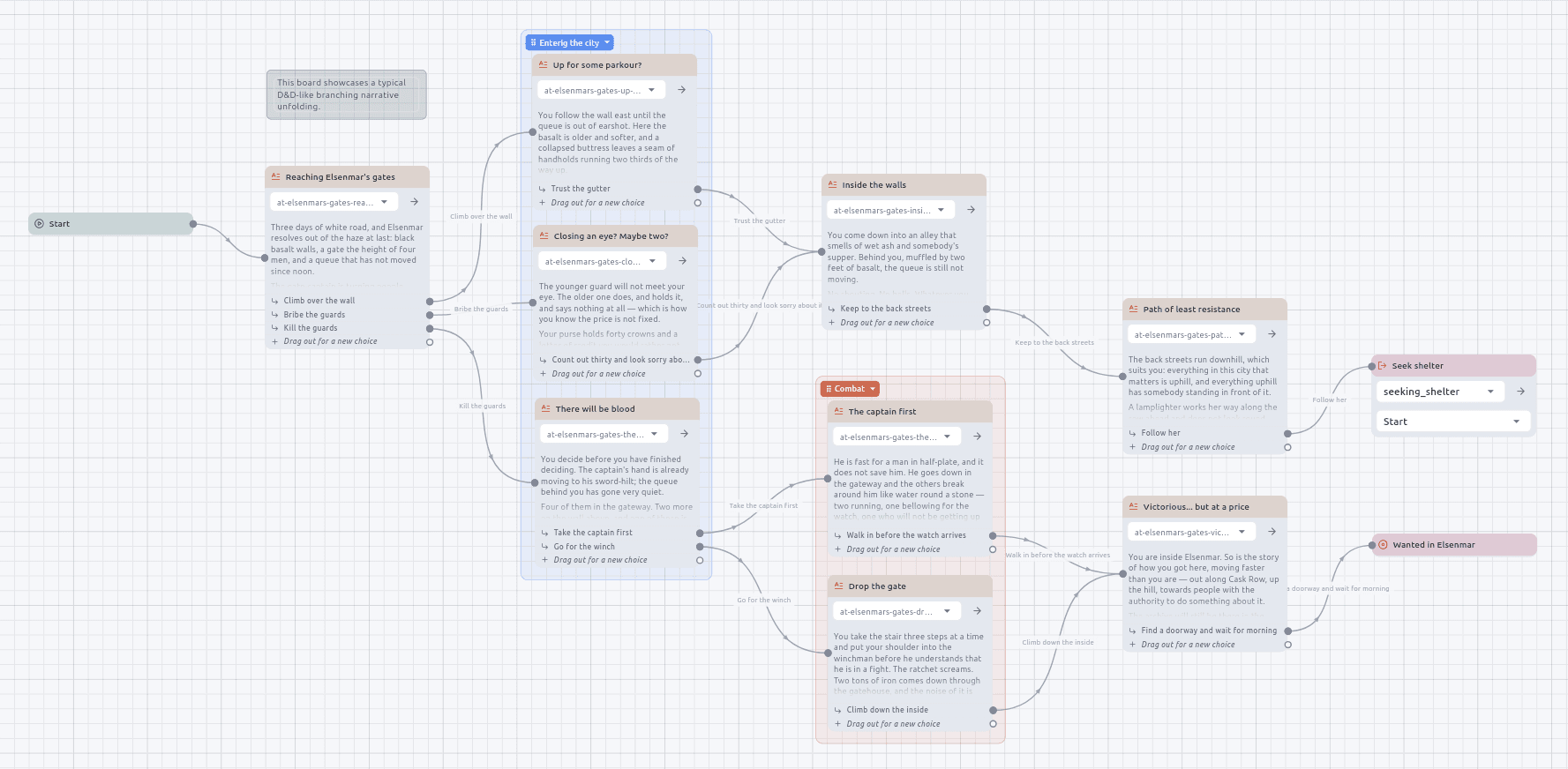
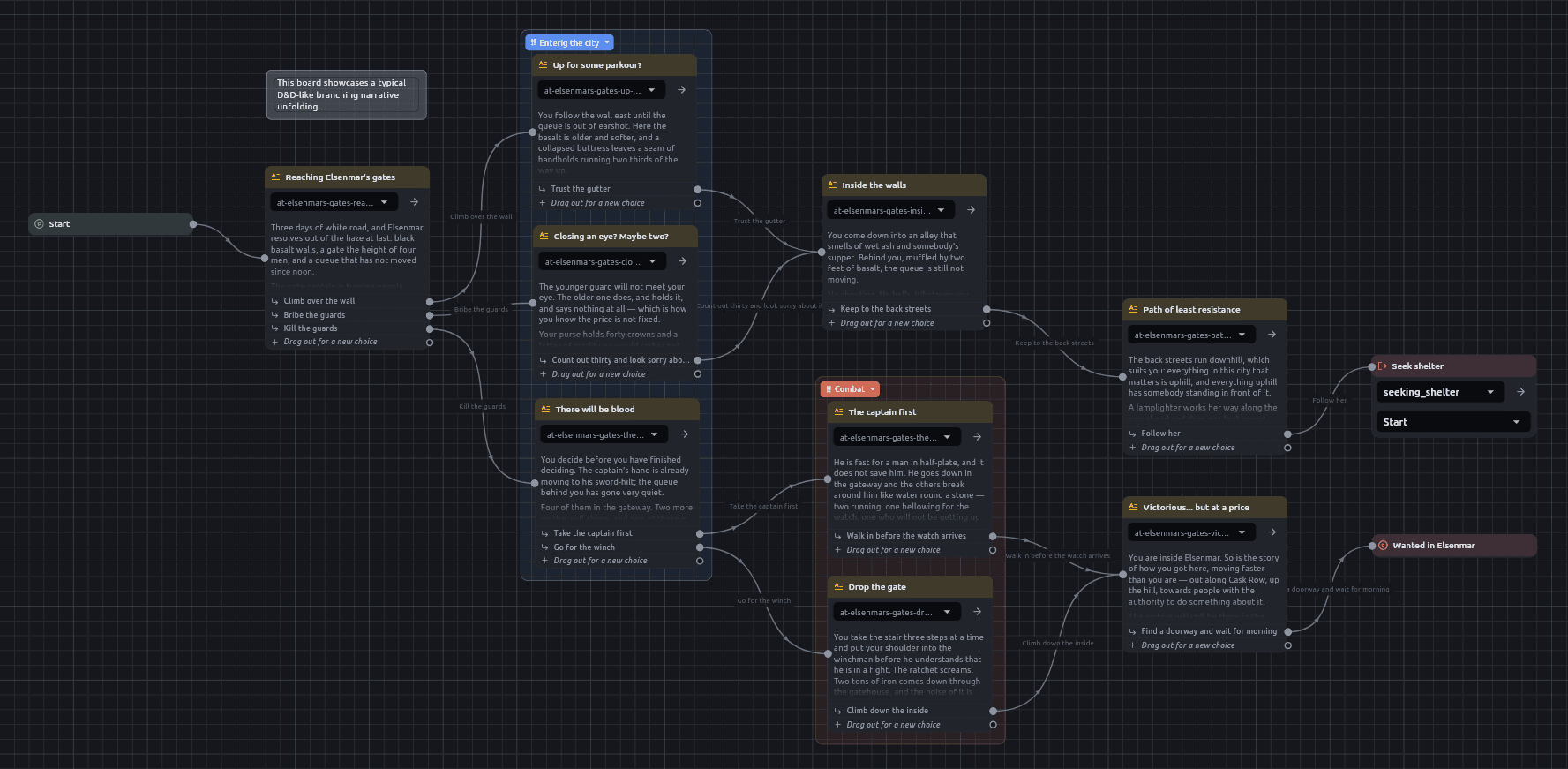
A canvas that knows what a story is
The editor supplies geometry, wiring, selection, undo and execution. Everything above it — passages, choices, chapters, components — is there because a branching story needs it.
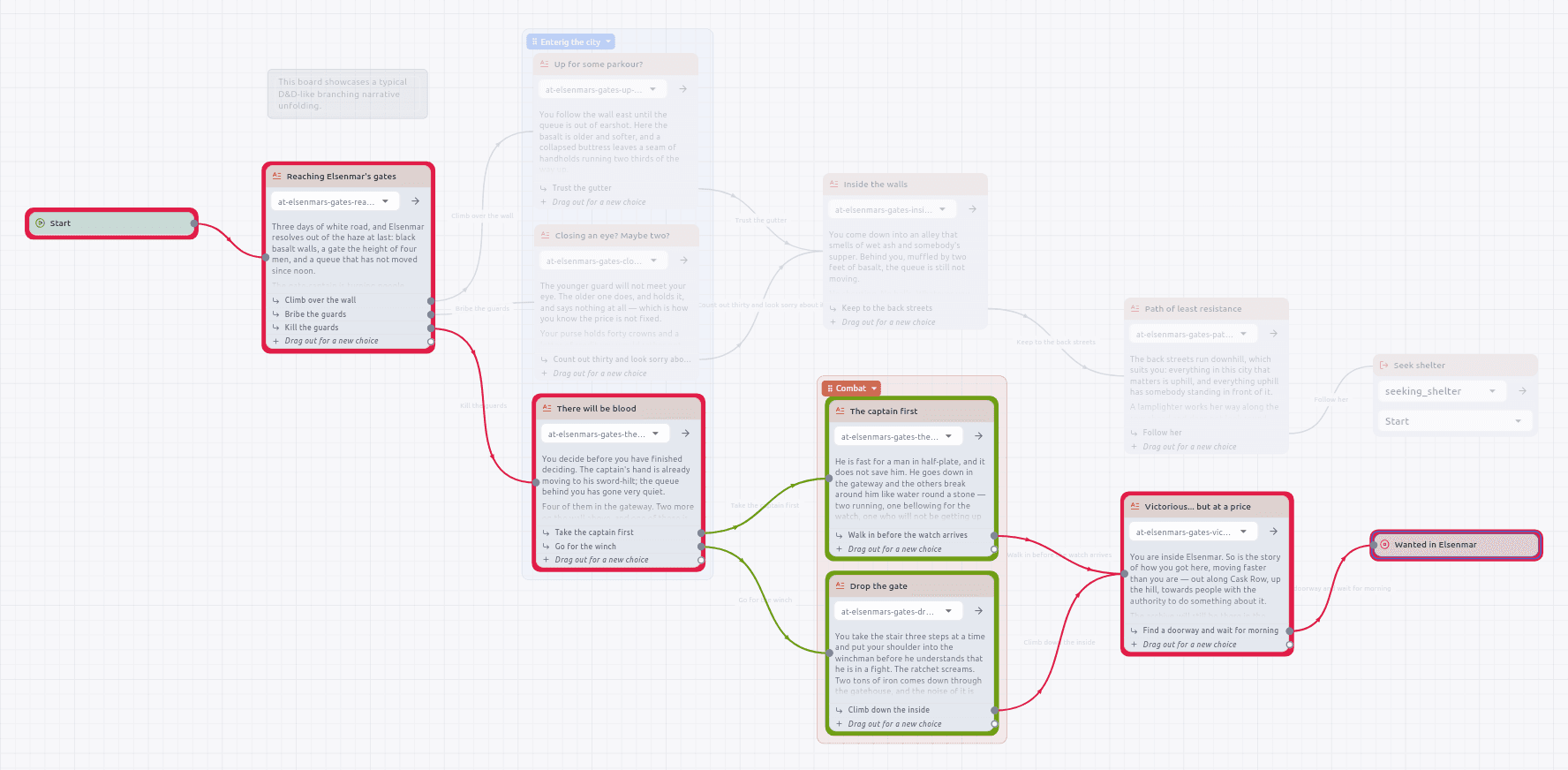
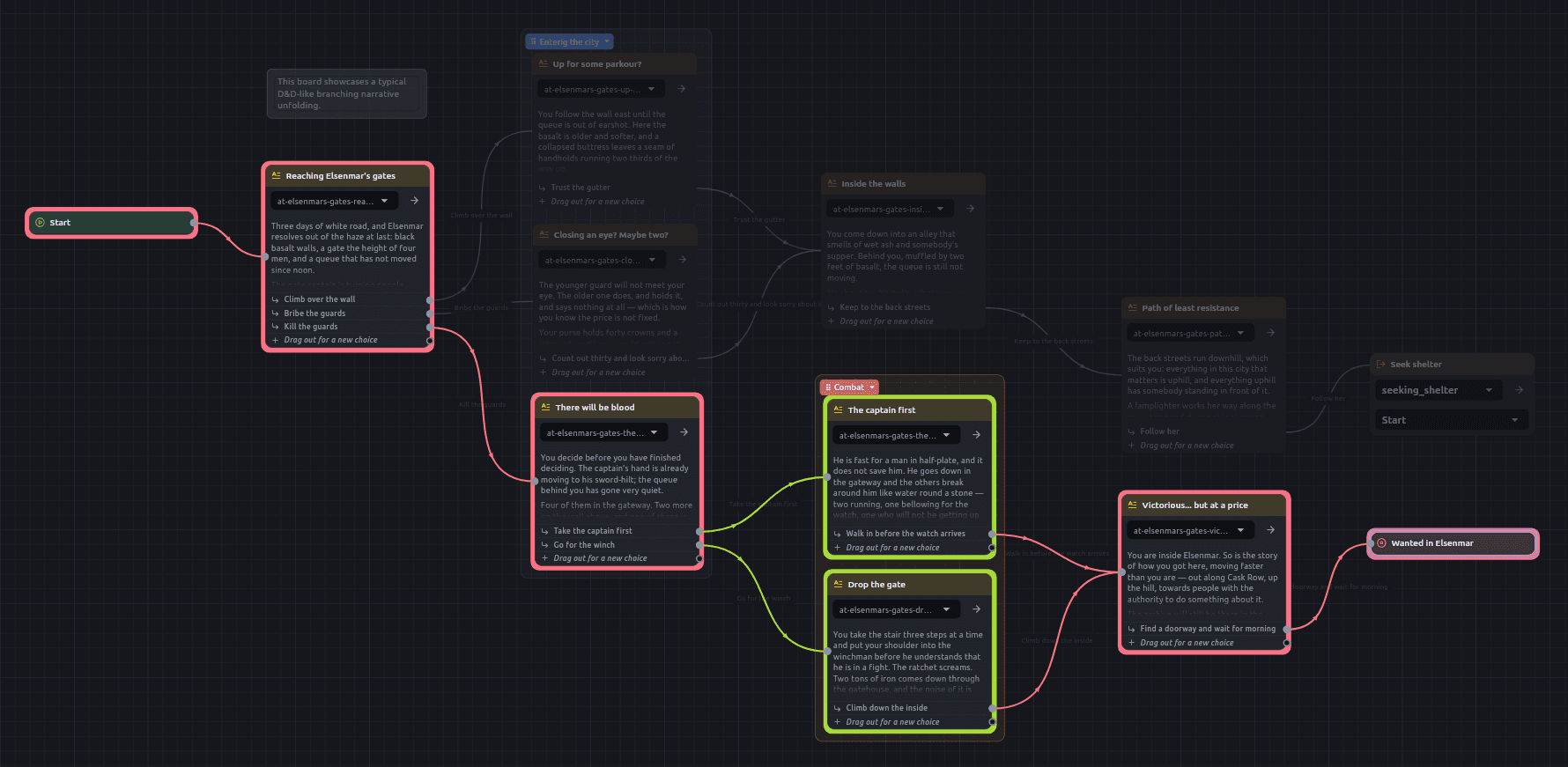
Ask how a reader could possibly have got here
Pick two passages and every route between them is drawn in colour while the rest of the board goes under a scrim. Runs that meet never share a hue, so the place where the routes part is the place the colour changes.
- Or pick one passage and ask what leads here, from wherever the story begins
- Cycles are fine — a loop back to an earlier chapter is drawn, not refused
- When a route arrives through another board, both boards open on one canvas
Walk the story you just wrote
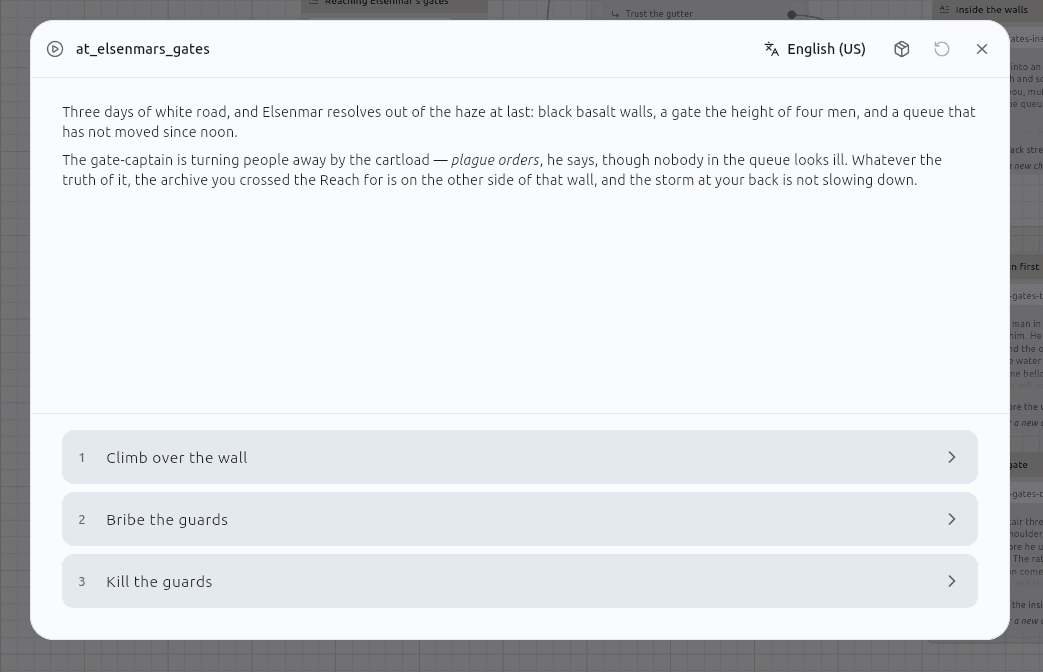
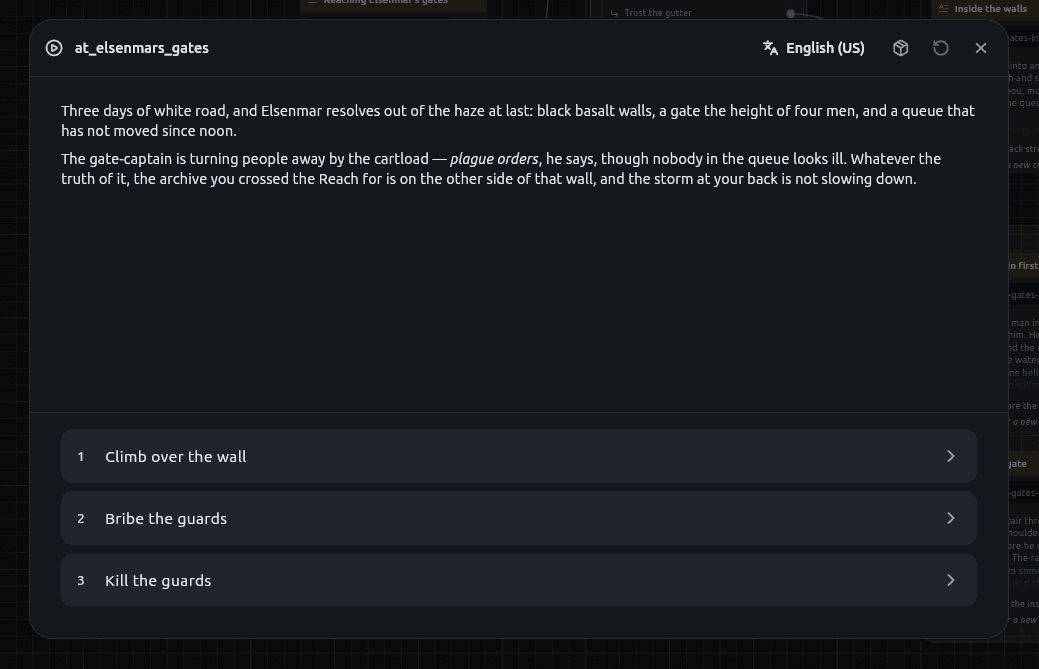
Press play and the graph runs: prose renders, choices become buttons, and the flow follows the wires across boards. A playthrough can be put down and picked back up, and the board can be edited while it is down.
- The checkpoint is a node id, so resuming re-reads the edited board
- A playthrough is ephemeral — nothing new is written into your folder
- Component instances survive the pause; what the story changed is kept
Real Python, in a sandbox that says what it can do
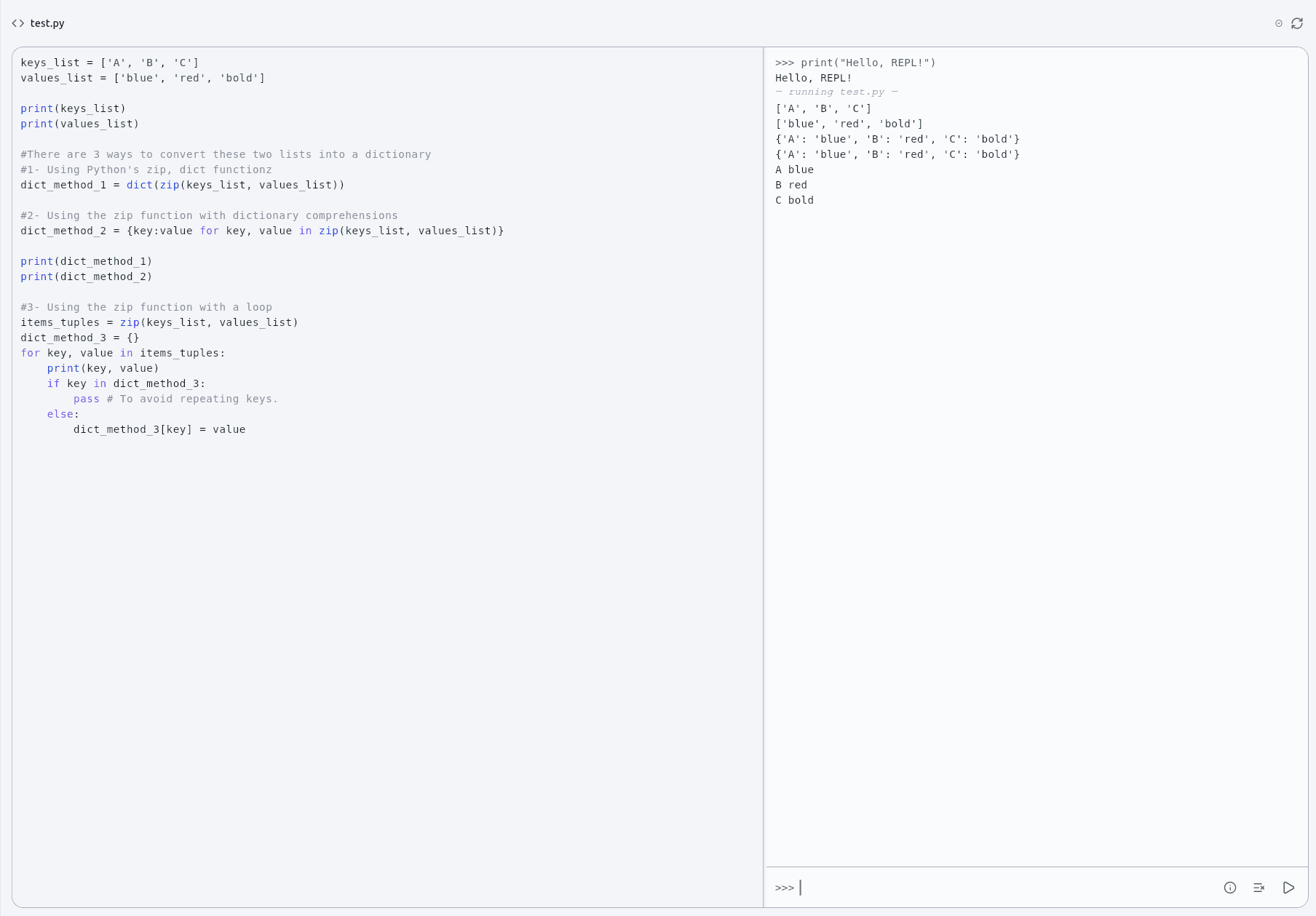
Script and Display nodes run a restricted Python subset on a background isolate, and prose can hold it too — a fenced block or a {{ … }} span, so a sentence can vary instead of forking into two passages.
- Values cross as native types: hp - damage is arithmetic, not a parse
- A traceback points at the line you wrote, not at generated scaffolding
- The sandbox panel probes the interpreter rather than describing it
One passage, every language, one document
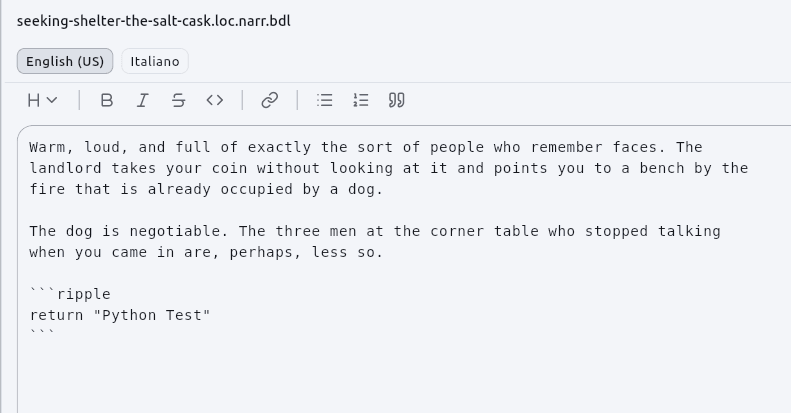
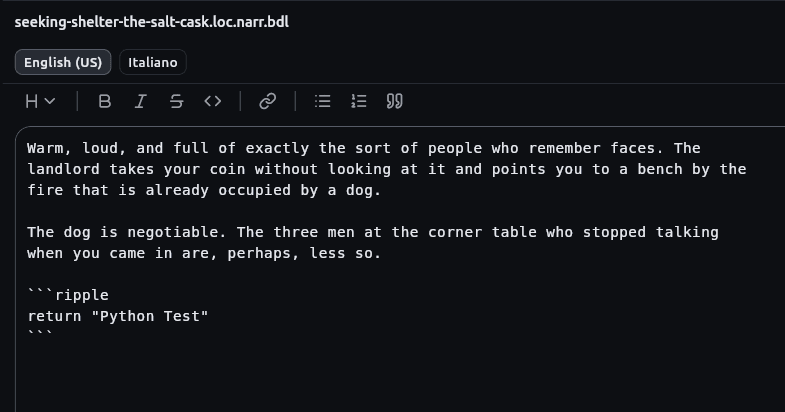
A passage is a folder holding one Markdown file per language, shown as a single file. A translator handed it can work in any editor, and a git diff still reads as prose.
- Choices are translated too — an untranslated one is a button nobody can press
- A translation that has fallen behind its source says so, and says why
- A language with no text says so rather than quietly falling back to English
See how the chapters hand the story on
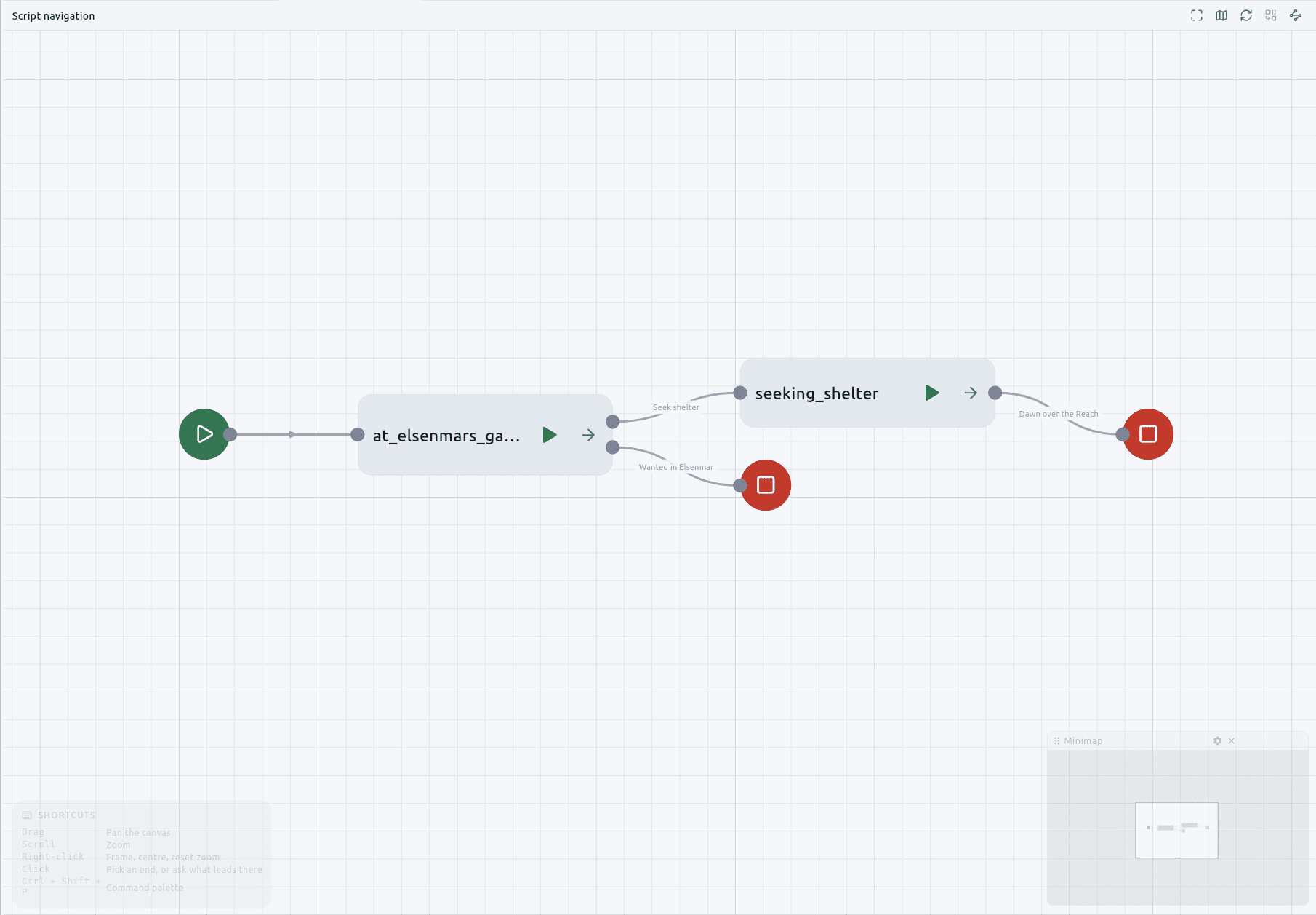
A read-only map of the whole project, laid out left to right in the order the story reaches things. The arrangement is deterministic, so a screenshot in a bug report means the same thing tomorrow.
- A start marker where a thread begins, a stop where one ends
- Play or open any chapter straight from its card
- Trace across chapters here the same way you trace across passages
The things a story keeps track of
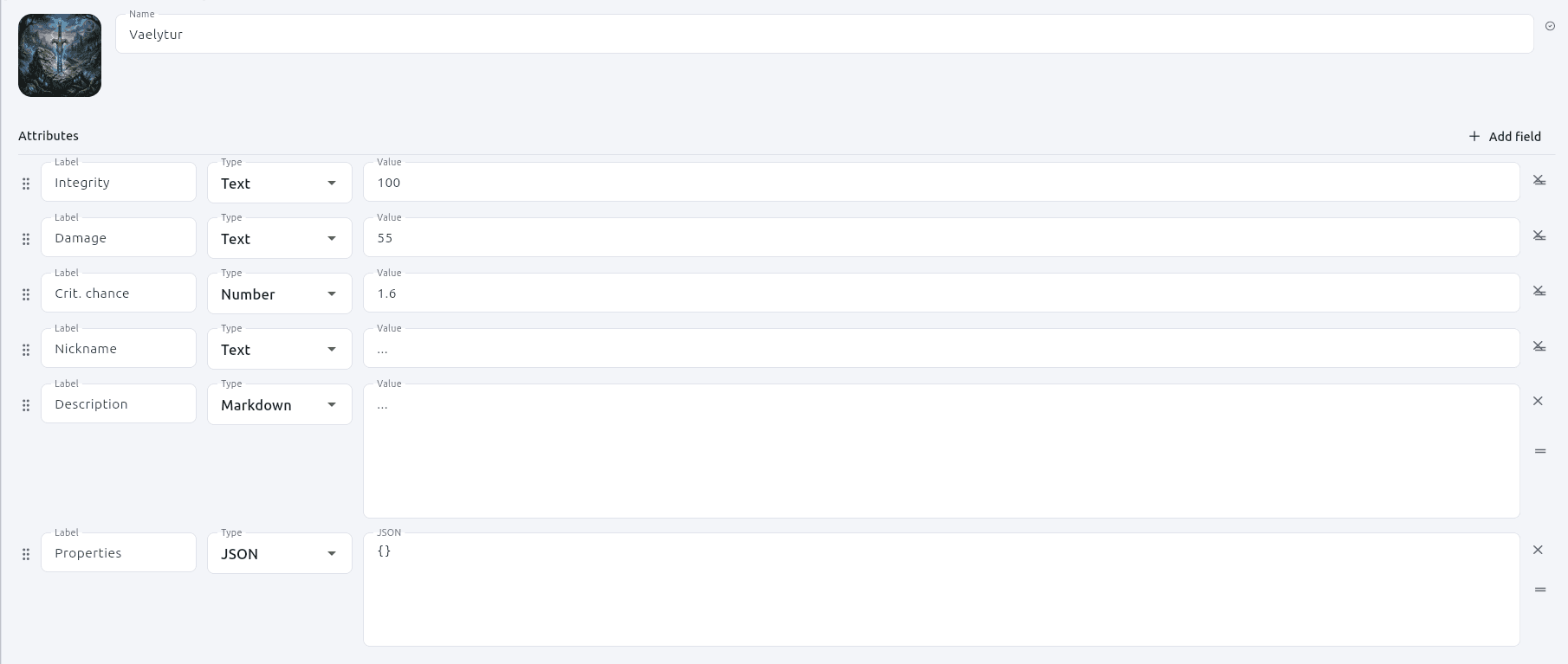
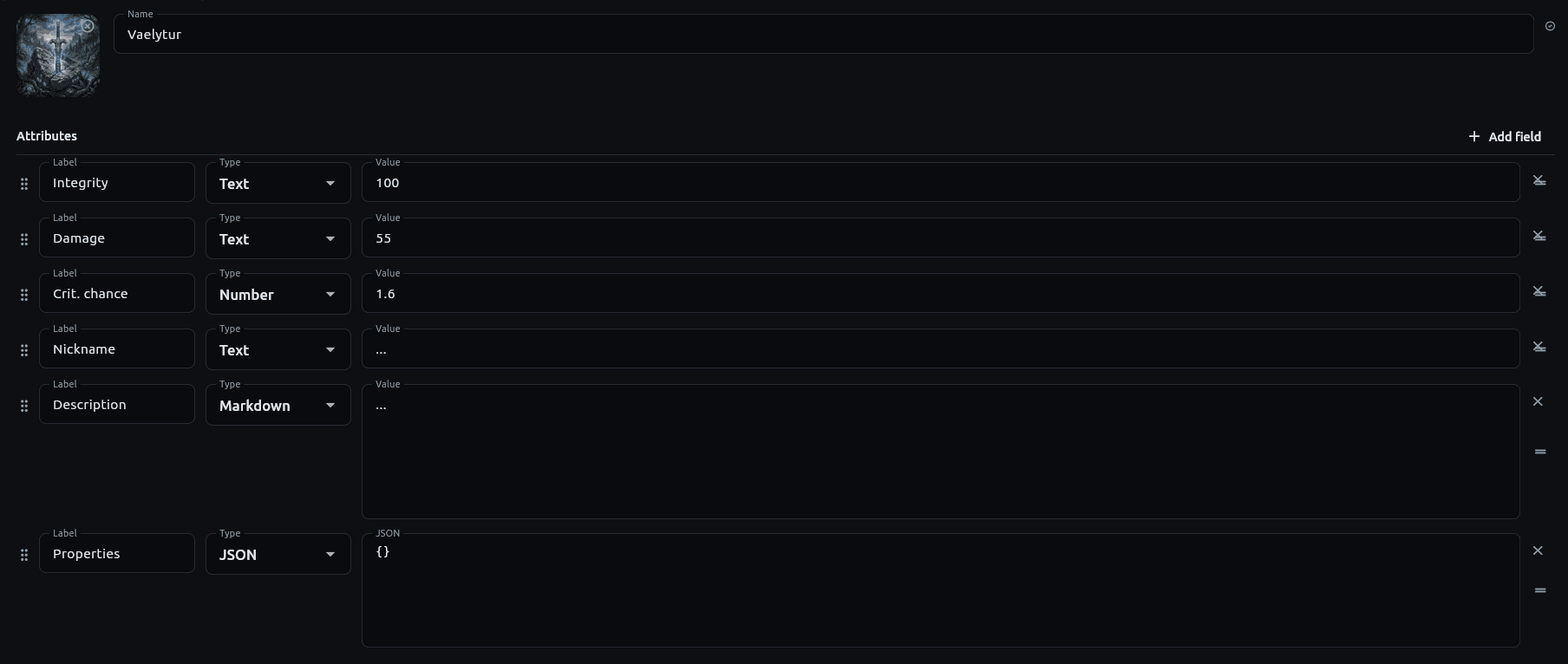
A sword, a character, a faction — a name and an ordered bag of typed attributes, with no schema behind it. Drop one on a canvas and it arrives with one typed output per attribute.
- Numbers stay numbers and JSON stays decoded; nothing is stringified in transit
- An instance is keyed by name, so a later board is holding the same sword
- Reordering a component's fields carries the wires with them
Hand the folder to an agent and keep writing
Ripple Effect is an MCP server. Point Claude Code — or anything else that speaks the protocol — at the project you have open, and it works in the same folder you are working in, on the board you are looking at, while you are looking at it.
project_infoproject_outlinecatalog_findboard_readboard_linkspassage_readcomponent_readdiagnostics_readtrace_betweentrace_intotranslation_statuspython_capabilitiespython_evalcampaign_startcampaign_statecampaign_choosecampaign_autoplaycampaign_endpassage_createpassage_writecomponent_writeboard_add_passageboard_add_nodeboard_connectfile_createsaveboard_set_nodeboard_set_choiceboard_disconnectboard_remove_nodefile_movefile_delete32 tools, plus six resources and two prompts. Everything that writes is behind the second switch.




Two switches, both off
Agent access makes the app listen at all. Agents may edit is separate and subordinate to it. Neither is on when you install.
A socket, never a port
The server is inside the running app, reached over a local socket by a bridge the client spawns. Nothing is listening on the network.
Edits go where yours go
A board is changed through its own session, so the edit lands in your undo stack. Every write says which paths it touched, and posts to Messages.



Version control for people who have never used it
Git, for a folder of prose, aimed at somebody who has never needed it and should not have to start now. It is a panel in the app rather than a terminal beside it — and because the repository underneath is an ordinary one, anybody on the project who does know git carries on as normal.
- Save points instead of commits, storylines instead of branches — the words are the ones a writer already has
- libgit2 is compiled into the app, so there is nothing to install and no git on PATH is consulted
- Status dots in the ordinary file tree, and a third tab beside Files and Messages
- Set a change aside and come back to it, with a safety net that says where the work went
What is shipped, and what is next
Each release is a pack of features with a name. The order is the order they are planned in — there are no dates here, because the honest thing to say about a version that has not started is what it is, not when it lands.
Tavern Meetup
- Boards, components and narration bundles
- Playable campaigns
Mimic Chest
- Version control
- MCP server for agents
Homebrew Rule
- Markdown rendered to styled HTML, for exports that carry a house style
Illusion School
- Integration with the Recraft V2 API
Grammar Lich
- Integration with an orthography-checking service
Familiar Spirit
- LLM integration for generative narration
Multiclassing
- The core story engine ported to other languages, for game engines and other third-party integration
Party Gathering
- Real-time collaboration
World Smith
- Timelines and storyboarding
- Indoor and outdoor maps
- World wiki
For anything whose shape is the paths through it
It began as a tool for D&D prep. What it turned out to be is a place to write anything that branches.
- Tabletop prep
- A session that survives contact with the table. Branches you did not plan for are a wire away, and the components remember what the party did to them.
- Quest and dialogue trees
- Choices on the wires, conditions on the nodes, and an export a build pipeline can read without knowing this app exists.
- Game design documents
- The interesting part of the document is the paths through it, and a graph is what that shape actually looks like.
- Interactive fiction
- Markdown prose, real branching, several languages in one document, and a play mode to read it back as a reader would.
Questions worth asking first
Open a folder and start writing
No account, no project scaffold, nothing written into your directory that you did not ask for.